
Resources
Cybersecurity white papers, data sheets, webinars, videos and more
Resource Library

Blog
What Is IP Reputation and How to Protect It?
Learn what IP reputation is, how it impacts your business, and how continuous monitoring protects your organization and vendor ecosystem from threats.

Blog
What Is Endpoint Security and Why Does It Matter?
Learn what endpoint security is, why it matters for your organization, and how to protect every device on your network from modern cyber threats.

Blog
What Is Internet Intelligence?
Internet intelligence turns raw web data into a real-time view of your exposure and third-party risk. Learn what it is and how it works.

Blog
What Is Threat-Informed TPRM and Why Compliance-Driven Programs Leave You Exposed
Compliance-driven TPRM programs document risk — they don’t reduce it. Learn what threat-informed third-party risk management looks like and why the difference matters when attackers move in hours.

Webinars
When AI Moves Faster Than Your Security Team: Leading On Cyber Risk in 2026
Learn more in this resource.
Video
Unlock the Hidden Power of DriftNet’s Summary Page
A Driftnet tip for threat hunters: how the summary page reveals co-hosted domains and certs that hint at what an IP is really being used for.
Demo Tuesdays
Video
Mastering Driftnet: Power-Filtering Strategies for Threat Hunters
See how Driftnet’s Add Filter and Add to Query options let you narrow, exclude, or reset artifact searches without losing your original results.
Demo Tuesdays

Blog
Botnet Threat Intelligence From Sinkhole Telemetry
Sinkhole telemetry turns botnet check-ins into botnet threat intelligence. See how we detect infected devices across your vendors.

Blog
How Ransomware 3.0 Changes Your Risk Exposure
Ransomware 3.0 runs autonomously on AI. See how security teams can harden defenses, monitor third parties, and stay ahead of this new threat.
Video
Hunting LapDogs: Threat Research with Driftnet
See how STRIKE’s threat intel team uses DriftNet to pivot on certificate fingerprints and uncover new LapDogs ORB network indicators.
Demo Tuesdays
Blog
Why Traditional Vendor Questionnaires Are Outdated
Vendor questionnaires were built for a slower era. Learn why point-in-time assessments fail modern security teams — and what threat-informed TPRM looks like instead.

Blog
What Is Continuous Threat Exposure Management (CTEM)?
Continuous threat exposure management (CTEM) is a five-stage Gartner framework to find, validate, and prioritize the exposures attackers can exploit.
Video
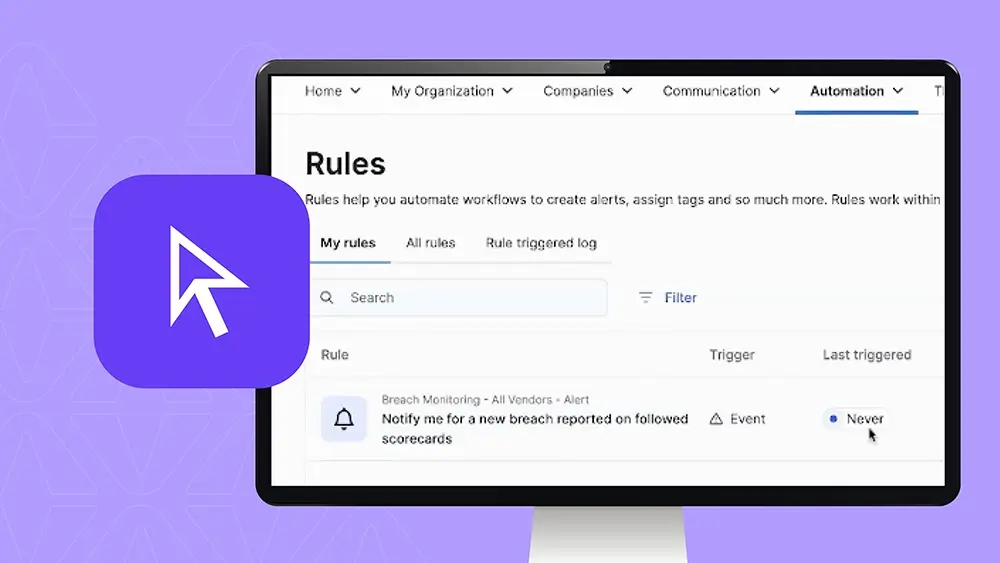
TITAN Watch – Rule Builder Agent
Learn how SecurityScorecard’s Rule Builder agent automates vendor risk alerting, from breach monitoring to score threshold triggers. This step-by-step walkthrough shows how to set up a fully configured alert in minutes, without manual rule-building or risk of duplication.
Demo Tuesdays

Blog
Security Tool Sprawl Is Its Own Attack Surface
Security tool sprawl creates real security risks. How data silos, redundancy, and alert volume widen your attack surface, and how to consolidate.
Blog
What Are DORA Compliance Requirements
Learn what DORA compliance requirements mean for financial entities, from ICT risk management and incident reporting to third-party oversight.

Blog
Scorecarder Spotlight: Emmy Chau
Our “Scorecarder Learning & Development Spotlight” series showcases our talented, driven employees, the incredible work they do, and their quest to continue their development as lifelong learners. Name: Emmy Chau Role: Senior Manager, FP&A “One of the things I appreciate most about SecurityScorecard is the opportunity to keep learning. Whether it’s partnering with teams across
Scorecarder Spotlight

Research
Catch Me If You Can: Inside the Anonymization-for-Hire Network
In this briefing, Wade Lance VP, Product Marketing & Sales Enablement walks through STRIKE’s newest report Catch Me If You Can.
Wade takes viewers inside the full commercial stack behind CanOworms — tenants, relay fleet, resellers, and landlord ASNs — and explains why treating a threat-feed-flagged C2 as a single actor’s infrastructure can lead defenders to the wrong conclusion entirely.
This isn’t a read-through of the report. It’s Wade’s field-tested take on what the findings mean for how security teams should actually hunt this kind of infrastructure.
Download the briefing now.
STRIKE Alert
STRIKE News
STRIKE Team

Blog
What Is Internet-Wide Scanning, and How Attackers Use It
Internet-wide scanning lets attackers find exposed hosts fast. See how it works and how to spot your exposure before they do.

Blog
How SOC Automation Improves Threat Response
SOC automation helps security teams respond faster, cut false positives, and scale operations. Learn the top use cases, benefits, and challenges.

Blog
Inside CanOworms: The 633-Server Proxy Network Hiding Criminal and State-Linked Activity
SecurityScorecard’s STRIKE team uncovered a 633-server anonymization network used by commodity malware operators and suspected state-linked actors, revealing how attackers rent shared infrastructure to evade traditional defenses.
STRIKE Alert
STRIKE News
STRIKE Team

Research
Catch Me If You Can: New Research Reveals CanOworms, a Proxy Network for Hire
Blocklists, geolocation, and ASN reputation all share one assumption: that an IP tells you who’s behind it. CanOworms is built to break that assumption. STRIKE identified 633 confirmed member servers operating as a shared Squid/SOCKS/OpenVPN/IPsec relay fleet — not a command-and-control panel, but the disposable front in front of one. Dozens of tenants, from Remcos and Quasar operators to suspected APT41 and APT43/APT37 infrastructure, have used these same relays. The operator is unattributed by design. Many tenants, one set of relays.
What you’ll learn:
How the mesh was found. A shared self-signed TLS certificate (O=kickass), corroborated by JARM and JA4X fingerprints, exposed 633 confirmed nodes out of 748 candidate IPs across a dozen dense /24 blocks, six-plus hosting providers, and more than a dozen countries.
How it’s run. Five Czech Republic control-plane hosts manage the fleet in a centralized “star” topology, with one node alone touching roughly 256 others and a fleet-wide ~35-second heartbeat back to a single collector — a pressure point defenders can watch.
Who’s renting it, and who isn’t. A reseller called “PrivacyFirst” (MAXKO d.o.o., AS214366) surfaces in the paper trail, but only a fraction of its address space actually carries the mesh certificate — a case study in why reseller identity isn’t operator identity isn’t tenant identity.
Where the attack traffic lands. Suspected credential-spray traffic exits the fleet toward MikroTik routers, TR-069 CPE, and Hikvision cameras — concentrated in South Africa, India, the U.S., Brazil, and Bangladesh. Commodity-crime geography, not espionage-target geography.
Why IP-based defense fails here, and what to fingerprint instead. The report lays out why durable detection means tracking how the infrastructure was built (certificate thumbprints, JARM, JA4X, service-stack signature) rather than chasing IPs that get burned and replaced faster than blocklists can keep up.
Full IOCs and MITRE ATT&CK mapping. Appendix A publishes the complete fingerprint set — ready to drop into detection tooling — mapped to ATT&CK Resource Development and C2 techniques (T1583.003, T1090.002, T1571).
Download “Catch Me If You Can” for the complete CanOworms research, including the fingerprint methodology, control-plane analysis, and the full IOC appendix.