Transcript
Breach and threat intelligence today is scattered. It’s buried in news coverage, hacker forums, and breach reporting.
By the time your team manually connects this information to your supply chain, you’ve already lost response time.
Most third party risk platforms only give you a delayed disclosure, not real time context on why it matters to you.
That’s exactly what Security Events in Titan Secure solves.
The Security Events feature represents one centralized feed of external breaches, zero days, and emerging threats across your entire supply chain.
Instead of you performing the manual correlation, the platform automatically maps fragmented signals directly to your existing data.
Other platforms hand you ROF, threat feeds, or generic advisories, while Titan Secure connects the information directly to your portfolio, so you skip the manual triage entirely.
Let’s look at how you would use this day to day.
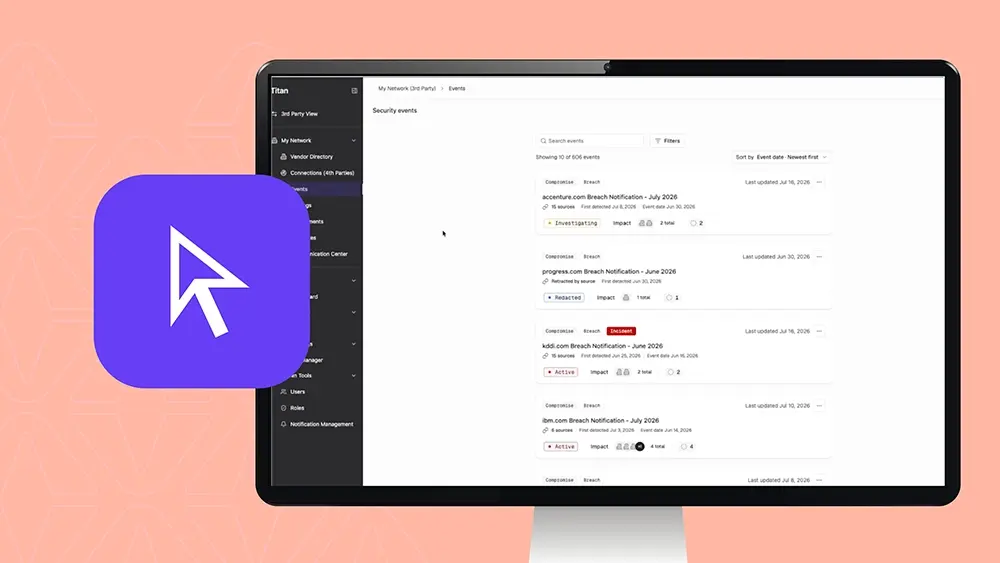
The security events page is a live feed built for fast scanning.
New developments surface immediately, so nothing sits unnoticed.
Each event card gives you the who, what, and when at a glance.
Event tags distinguish confirmed incidents from unverified chatter.
For example, a compromise tag with a breach subtype means it’s confirmed, as it is in this example, whereas a threat tag with a hacker chatter subtype means it’s alleged.
Status badges tell you exactly where things stand. Are they active or are they still being investigated?
And the impact summary displays vendors affected, along with confirmed and potentially affected vendor counts. Now let’s go deeper. Selecting an event opens a full investigation workspace. No more toggling between news sites, forums, and spreadsheets.
At the top, the description gives a plain language summary of the vulnerability, attack, or breach, including overall analysis and technical details. On the right, you will see the supply chain impact.
The impact summary breaks the event down at a portfolio level.
The vendor impact translation displays confirmed versus potential exposure, And a response progress bar tracks who’s responded, who’s pending, and who hasn’t been contacted.
While the impact result donut chart splits vendors by impact type.
As you scroll down, you will see a timeline, which is a chronological view of when the event was first detected, and when new sources or intelligence were added so you can see exactly how the story develops.
Every source that we have used to identify and validate the event is listed right here, fully cited for transparency. And finally, the vendor overview table lists every vendor potentially affected by the event.
You will be able to see why the vendor is linked. In this case, this is a fourth party connection.
You will be able to see the current investigation status and the outcome of the impact analysis.
Competitors typically stop at here’s a breach, while Titan goes much further in giving you evidence, escalation readiness, and vendor level response tracking, all in a single pane of glass. The security events are not just alerts, but alerts plus context plus action.
This feature helps teens move from reactive noise sifting to proactive evidence backed decision making.
Titan Secure gives you faster triage, cleaner and clearer escalation paths, and full transparency into how a single event ripples across your entire vendor ecosystem.
About SecurityScorecard
SecurityScorecard is the global leader in threat-informed third-party risk management (TPRM), securing the world’s supply chains. The company delivers a threat-informed approach to TPRM that enables organizations to drive out risk at the source. The platform uses continuous visibility and AI-accelerated workflows to help organizations reduce third-party risk before incidents occur and respond with confidence when they do.
Trusted by over 3,300 organizations, including 70% of the Fortune 100, and recognized as a trusted resource by the U.S. Cybersecurity and Infrastructure Security Agency (CISA). Backed by Evolution Equity Partners, Silver Lake Partners, Sequoia Capital, Google Ventures, and Riverwood Capital, SecurityScorecard delivers end-to-end supply chain cybersecurity that safeguards business continuity.