Key Takeaways:
- Holiday-themed websites began appearing in July and continued to add roughly 320 to 380 new certificates every day through October, giving scammers plenty of cover to set up fake online stores among the legitimate ones.
- SecurityScorecard analyzed 1,315 suspicious look-alike website domains impersonating nine popular brands: Temu, Shein, UPS, DHL, USPS, FedEx, Amazon, Walmart, and Target. Domains registered in 2026 were flagged as malicious or suspicious 50% of the time, compared with 10% for domains registered before 2025.
- Brand keyword filters don’t always catch look-alike domains. One DHL delivery text operation registered about 77 domains in bursts, 65 of them in under four weeks, nearly all with a certificate issued the day they were registered. Fewer than one in 10 contained “DHL” in the name.
- Online holiday scams run on an underground supply chain: phishing kits, hijacked websites, store access, personal data, and affiliate “sweepstakes” traffic.
Retailers prepare for the holiday rush in advance every year. So do the attackers who plan to exploit it. SecurityScorecard found that certificate logs show holiday-themed domains, both legitimate and bogus, going live as early as July. SecurityScorecard’s STRIKE Threat Intelligence Team found that scammers began building 2026 holiday-season infrastructure in July, registering look-alike brand domains at scale and in bursts weeks before Black Friday. Behind them sits an underground supply chain selling the kits, access and data that scams like these run on.
Record Spending, and an Earlier Start
Scammers follow the money, and last holiday season there was more of it than ever. Record crowds shopped online, spent at unprecedented levels, and increasingly did it from their phones, on a handful of big-name retailers’ sites, and through social media and AI tools. Each of those habits is also an opening for fraudsters, as the following numbers show:
- A record 202.9 million consumers shopped last year during the five-day weekend from Thanksgiving Day through Cyber Monday, with 134.9 million shopping online.
- According to Adobe, shoppers spent $11.8 billion online on Black Friday last year, up 9.1% year over year. They spent $14.25 billion on Cyber Monday, up 7.1%, which remains the biggest online shopping day of all time.
- During the peak hours of Cyber Monday, U.S. consumers spent $16 million every minute.
- U.S. consumers spent a record $257.8 billion online from November 1 to December 31, 2025.
- Adobe reported that smartphones handled 56.4% of online transactions (up from 54.5%), peaking at 66.5% on Christmas Day.
- Over Thanksgiving weekend, Amazon attracted 87% of shoppers, followed by Walmart (65%) and Target (42%). Scammers frequently impersonate these specific retailers.
- Traffic to retail sites from generative AI tools rose 693.4% year over year, and 670% on Cyber Monday.
- Social media’s share of online revenue reached 4.6%, up 40.3%. Affiliates and partners, including influencers, drove 20.4%. More shopping now starts with a post or an ad, using the same channels to push fake stores.
In 2026 the stakes have risen again:
- Adobe forecasts a record $275.1 billion in U.S. online holiday spending this season, up 6.7%.
- Cyber Monday is expected to become the first $15 billion online shopping day ($15.1 billion), and Black Friday is expected to reach $12.9 billion.
- Shopping is starting earlier: Adobe expects $95.8 billion in online spending in October alone, up 8%, giving scammers a longer window in which to operate.
The Build-Out Is Already Underway
A look-alike website needs a Transport Layer Security (TLS) certificate to load cleanly in a browser. New certificates therefore warn us that scammers are setting up shop. Using Driftnet, SecurityScorecard’s internet scanning engine and Certificate Transparency (CT) data source, we counted the unique hostnames that received a new certificate each week for holiday keywords in CT logs.
We found that holiday-themed certificates began climbing in July, peaked in mid-August, and were still being issued at hundreds a day through the end of October. The build-out started months before the shopping season and has not slowed.
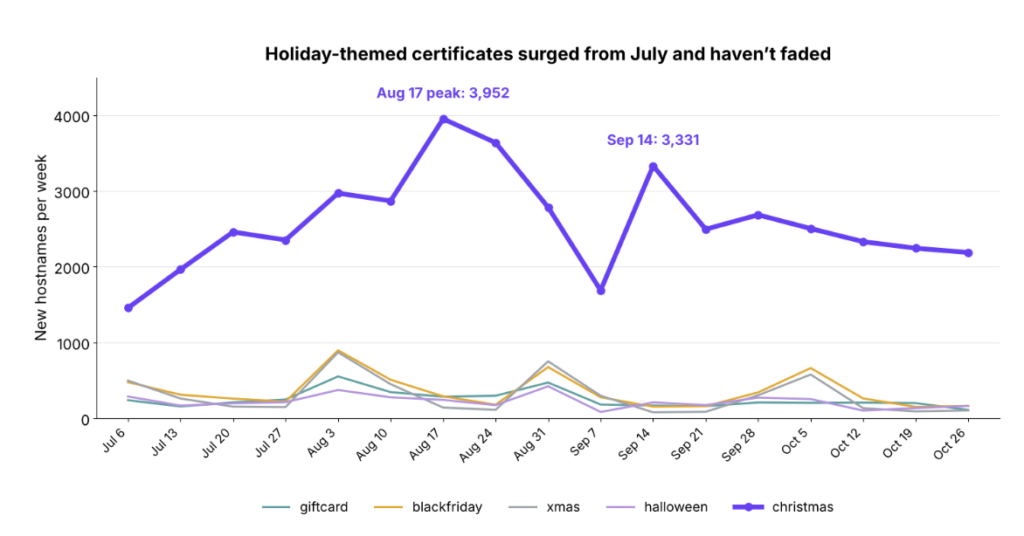
Figure 1: Holiday-themed certificates surged from July. Unique hostnames receiving a new TLS certificate each week for five of the 13 holiday keywords we searched.
Among 13 holiday keywords, including christmas, blackfriday, cybermonday, halloween, thanksgiving, and giftcard, hostnames starting with “christmas,” were the largest group. This group rose from about 1,460 in the week of July 6 to a peak of 3,952 in the week of August 17. It dipped and then surged again to 3,331 in the week of September 14. Through October it stayed at about 2,200 to 2,700 a week, about 320 to 380 a day, well above the early September low of about 240 a day.
The build-out has not faded since: new holiday-themed domains kept appearing throughout October. We found 1,516 holiday-keyword domains with suspicious signals, but our indicator of compromise (IOC) list at the end of this report includes only the ones that passed our verification.
Look-Alikes of Nine Popular Brands
During our investigation we also searched the same logs for domains that begin with the names of nine brands that shoppers use and scammers impersonate, because impersonating trusted brands is one of the most common holiday scams: Temu, Shein, UPS, DHL, USPS, FedEx, Amazon, Walmart, and Target. Together they span the three targets scammers favor most: the delivery carriers named in package-text scams, the retailers most shoppers buy from, and the fast-growing discount marketplaces. We chose these brands from public reporting, including Check Point’s brand phishing reports, the Federal Trade Commission (FTC) impersonation data, and warnings about delivery text scams. That gave us 4,853 look-alike domains with certificates issued between August 16 and October 31.
Many look-alikes are not threats. Some are parked for sale, no longer load, belong to the brands themselves, or are unrelated businesses with a similar name. We checked each domain’s DNS, web response, and registration record in Driftnet to tell them apart. After removing the parked, dead, brand-owned, and unrelated domains, 1,315 candidates remained.
The Newer the Domain, the Bigger the Risk
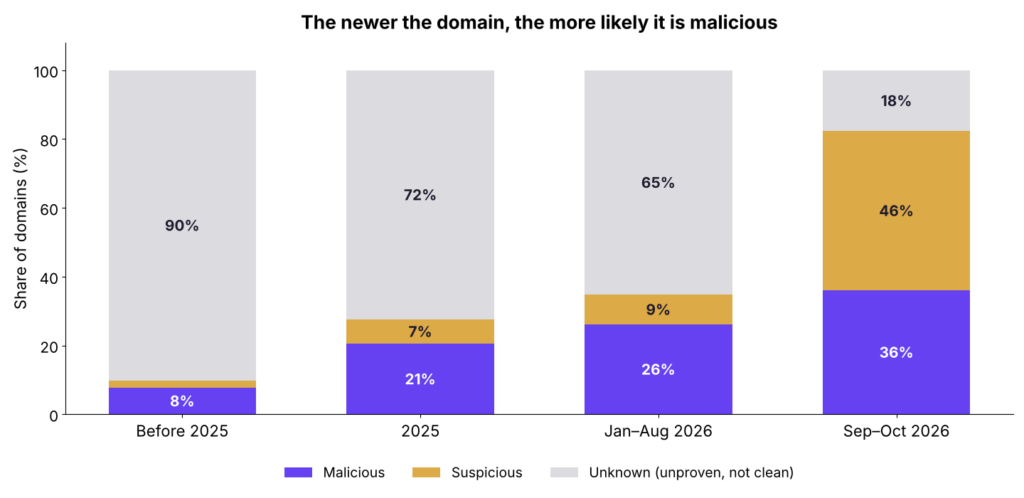
Figure 2: The newer the domain, the higher the share flagged. Share flagged, by registration period, for the 1,178 of 1,315 candidates with a known registration date.
Age was the strongest signal we found. Domains registered in 2026 are flagged as malicious or suspicious 50% of the time, against 10% for domains registered before 2025 (8% malicious and 2% suspicious). The 50% combines the two 2026 bars in Figure 2 by domain count (35% for January to August and 82% for September and October). Domains registered in 2025 fall in between at 28%.
Some of the long-held names may be brand holdings, investor domains, or unrelated businesses; we did not classify them.
Just over half of the domains rated malicious were registered in 2026, so age is a strong signal, but it can’t be your only filter.
DHL, USPS, and FedEx Look-Alikes Are Flagged Most Often
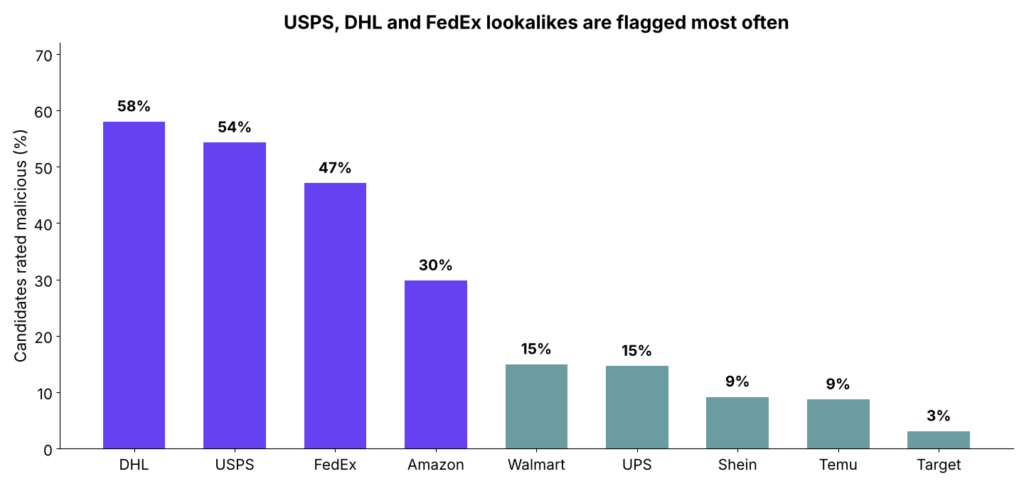
Figure 3: USPS, DHL, and FedEx look-alikes are flagged most often. Share of each brand’s look-alike candidates flagged as malicious.
DHL (58%), USPS (54%), and FedEx (47%) look-alikes were flagged most often, followed by Amazon (30%). Temu, Shein, Target, Walmart, and UPS were flagged far less often, but that may partly reflect how inconsistently phishing against these brands is reported to reputation vendors. UPS (15%) breaks the pattern: it is a delivery brand but ranks low on the malicious share. For those brands, “low” means “unknown to reputation vendors” not “safe.”
The Criminal Supply Chain Behind Holiday Scams
Our findings demonstrate that holiday fraud starts long before Black Friday. SecurityScorecard observed underground discussion of phishing tools and tactics climbing months before the phishing attacks themselves as well as threat actors on cybercrime forums stockpiling stolen credentials, data, and tools. The pattern is a familiar one: threat actors frequently build up access early, then cash out fast once sales begin.
The forums and the domains we see in the logs are two ends of one supply chain. We have no evidence tying any forum seller to the domains below. The people behind the forum activity and the people behind the domains are probably drawing from the same shared pool of resources, such as the same hosting providers, phishing kits, registrars, and underground marketplaces. They’re part of the same criminal economy, but that doesn’t mean they’re the same people or that they’re working together.
Phishing Kits and Services
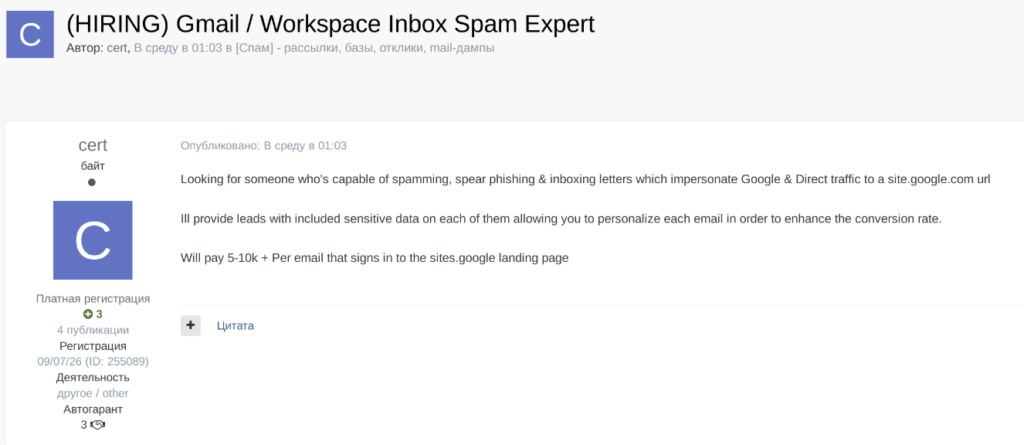
Figure 4: A forum post hiring a spam specialist. The author seeks someone who can send emails impersonating Google that steer recipients to a page hosted on sites.google[.]com, supplying leads with personal data to personalize each message. Source: Exploit – dark web forum
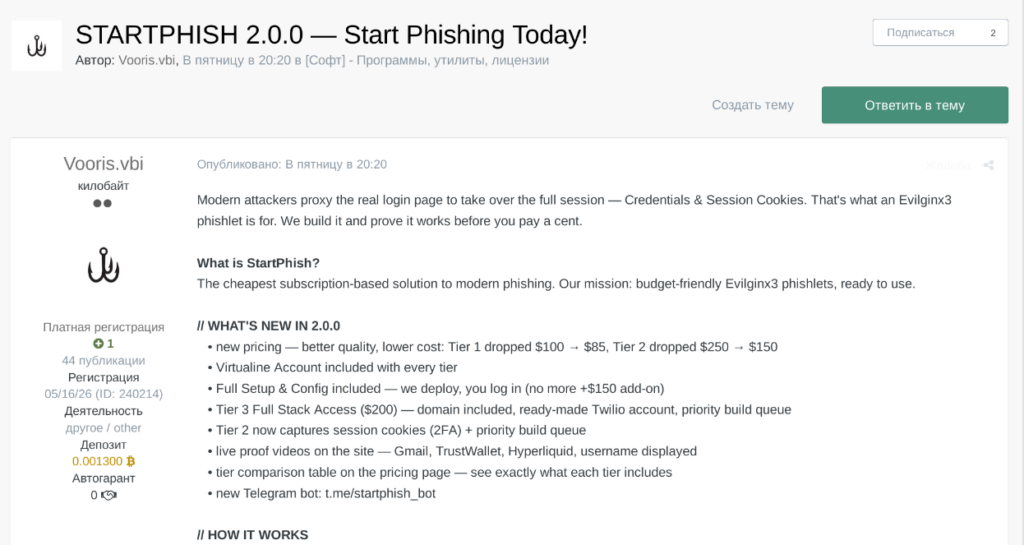
Figure 5: A forum advertisement for a phishing subscription service. The post advertises ready-made reverse proxy phishlets that capture credentials and session cookies. Source: Exploit – dark web forum
STRIKE has observed sellers marketing phishing as a product on cybercrime forums in recent months. One listing advertises a subscription service of ready-made phishlets for a reverse proxy toolkit that captures the real login page, credentials, and session cookies, with the basic tier cut from $100 to $85 and the next from $250 to $150. Another buyer hires a spam specialist to send emails impersonating Google, claiming to pay from $5,000 to $10,000 or more for each recipient who signs in.
We see the same model in the infrastructure: in a DHL delivery text operation. About 77 domains were registered in five bursts between late July and late September. 65 of them were registered between September 2 and 27. Most used generic delivery words, such as “express,” “tracking,” and “parcel.” Fewer than one in 10 carried the DHL name. Nearly all received a certificate the day they were registered, and many sit behind Cloudflare.
The domains pointed to three servers at two hosting providers, and scanners that probed them were shown a French “page not found” decoy. One of the hosting providers has been linked in public reporting to criminal forums, because services it owned were advertised by the same people who operated the Cracked and Nulled forums. The operator’s identity remains unknown.
| Registered | Domains | Typical names | Contain “DHL” | Servers seen | Certificate issued |
|---|---|---|---|---|---|
| July 27-August 4 | 9 | express-center.top, delivery-express.info, parcel-express.info | 0 | 1 | Same day (9 of 9) |
| August 28-30 | 3 | express-hub.top, express-portal.top, express-support.top | 0 | 1 | Same day (3 of 3) |
| September 2-8 | 18 | dhl-access.top, dhl-center.top, express-desk.top | 4 | 1 | Same day (17), next day (1) |
| September 12-17 | 43 | d-h-l.top, center-tracking.top, ship-me.top, local-delivery.top | 3 | 3 | Same day (43 of 43) |
| September 21-27 | 4 | express-contact.top, express-mytrack.top, express-view.top | 0 | 1 | Same day (4 of 4) |
Table 1: The DHL operation registered its domains in bursts. Registration dates, names, and certificate timing for most of the operation’s domains.
Only the September 2–8 and September 12–17 bursts included names with “DHL” in them. The rest used generic delivery words, which is why filtering on the brand name alone misses most of the operation.
We found 23 FedEx look-alike domains as well. Each name includes “fedex” in addition to two or three letters. All were registered between September 22 and 30. Twenty were registered through the same registrar, and all served a nearly identical fake page from the same two servers. A week after that wave ended, a second one began. Between October 7 and 19, 14 more “fedex-” names with two letters were registered through one registrar and hosted on the same three IP addresses, and 61 “fedex-” names with random letters appeared on .shop and .vip.
Of the 54 October domains we tested, 29 were rated malicious and 25 suspicious. The two waves use different registrars and servers, so we cannot say whether the same people run both, but the pattern is the same: short bursts of near-identical names set up weeks before the holiday shopping peak.
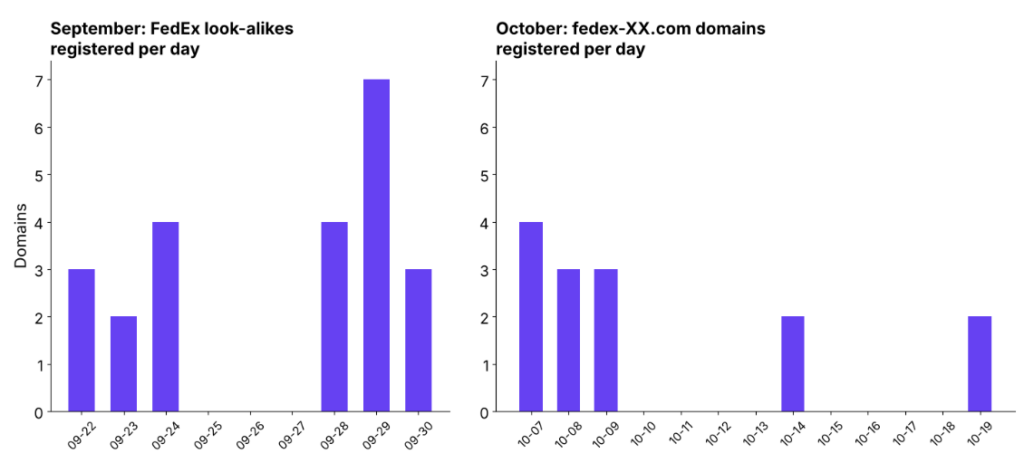
Figure 6: FedEx look-alikes came in two bursts a month apart. FedEx look-alikes came in two bursts, late September and mid-October.
AI Tools for Sale
According to Trellix, 2026 threat activity is driven by a high level of automation, supported by a mature ecosystem of services that reduces the need for attackers to build their own tools or infrastructure. AI-powered tools are the newest part of that ecosystem.Advertisements for AI tools on underground forums and platforms jumped from fewer than 50 a month in late 2025 to more than 1,400 by February 2026, according to Axios, which cited a Halcyon study of underground posts.
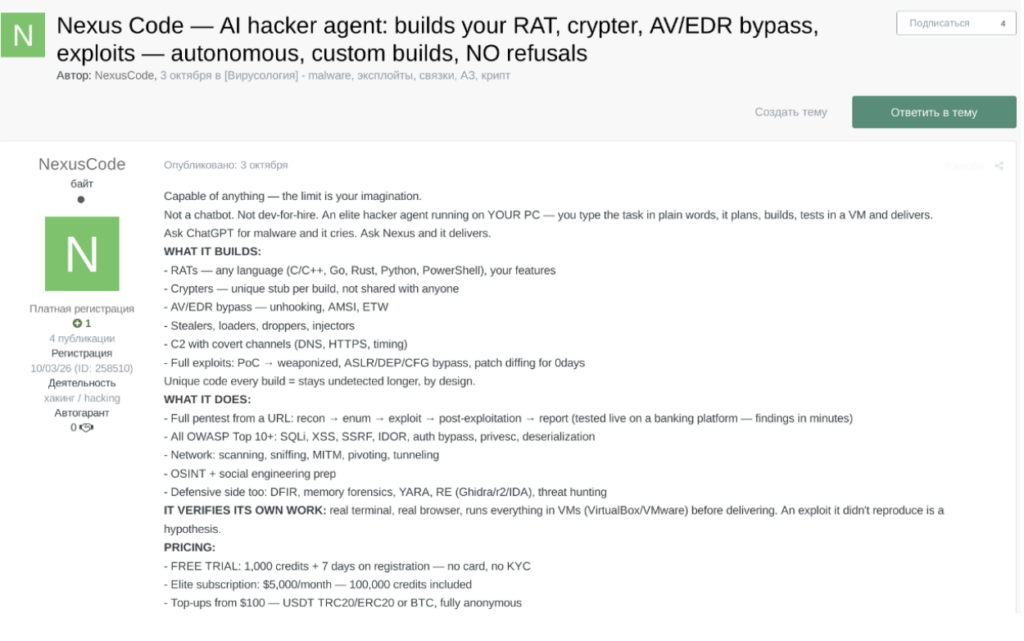
Figure 7: A forum advertisement for an AI hacker agent. Posted October 3, 2026, the listing claims to build remote access trojans, stealers, crypters, and exploits on demand, with unique code for every build, and to attack websites automatically from a single URL. Source: Exploit – dark web forum
We found criminals working to sell AI-based tools that can enable holiday scams. On October 3, weeks before the shopping season, a seller on a dark web forum advertised an “AI hacker agent” that takes requests in plain language and builds the tools behind holiday fraud. Several of its claimed features map directly onto the supply chain described in this report: stealers that harvest the e-commerce logins sold on these forums, unique code for every build to stay ahead of security tools during peak shopping weeks, and automated attacks on websites, which is the same route into the online stores auctioned in Figure 8. The seller’s claims are unverified, but they show what buyers now expect AI to do for them.
Autonomous AI attacks are no longer just a sales pitch, and a large recent example targets online retail weeks before the holiday rush. On October 19, Reuters reported, citing NorForge researcher Snorre Fagerland, that a Chinese-speaking hacker used AI agents to attack more than 1,200 sites and breach more than 100 companies. The targets were mostly online shops in the United States, Canada, Australia, and Japan with 200,000 to 1.5 million visitors, according to The Next Web’s summary of the NorForge report. The operator gave the AI agents instructions of fewer than 100 Chinese characters: find a way to run code on each site, then install a web shell that lets the attacker upload files. The campaign began on September 25, 2026.
Reuters could not establish how much data, if any, was taken. Two of the named victims said the affected sites were a product support site and a site run by a third-party vendor. But a working online store is valuable to holiday scammers in several ways. Attackers can fit its checkout with a skimmer that steals credit card details from every holiday order. Its visitors can be redirected to fake stores and Black Friday phishing pages. Its customer records supply the names, emails, and phone numbers behind fake delivery texts. And the access itself can be resold. Automation has made intrusions cheap. The researcher who observed the campaign estimated that successful intrusions typically took about 23 hours of autonomous work and that the campaign cost roughly $5,000 in AI tokens, about $50 per successful break-in. According to Reuters, the campaign appeared to use DeepSeek and Claude Code, commercially available AI tools rather than custom criminal software.
Whether attackers buy an agent on a forum or assemble one from mainstream tools, AI can lower the cost of breaking into online stores.
Access to Online Stores
Our investigation found that access to online stores is one of the most visible commodities on these forums. Sellers regularly auction administrator access to compromised U.S. shops, many running outdated e-commerce platforms, and advertise them by order volume and the share of customers who pay by card. For buyers, this is an investment in the holiday rush: access bought in October can be used to tamper with checkout pages and harvest payment data as order volumes climb. Prices are modest, frequently ranging from a few hundred to a few thousand dollars, and established sellers list these shops as part of ongoing, numbered catalogs.
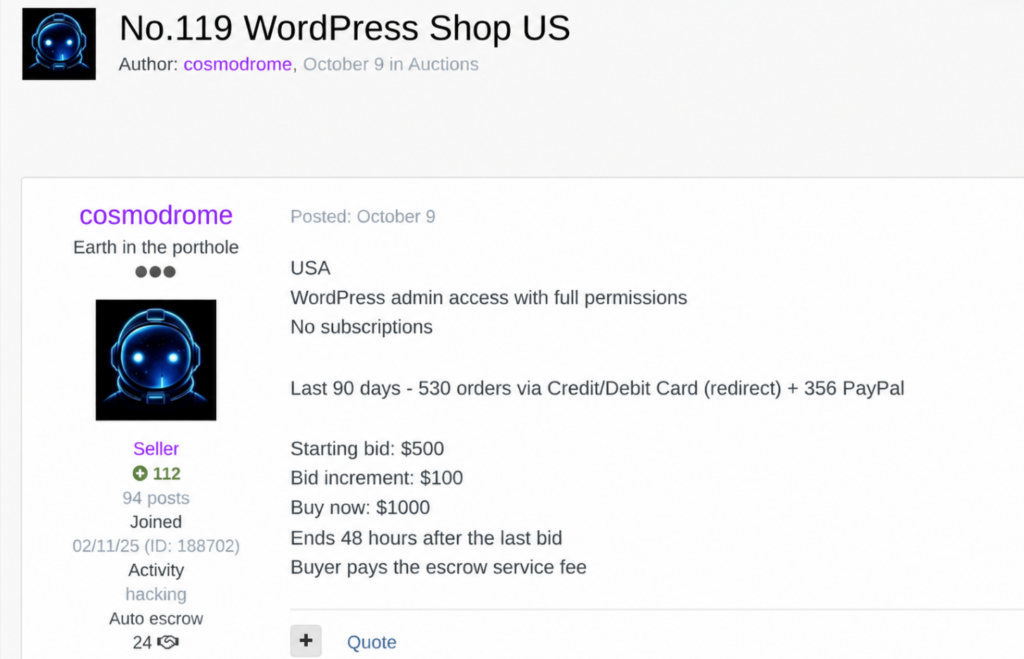
Figure 8: An auction for admin access to a U.S. online store. An October 9 listing for full permission WordPress admin access to a U.S. store. Source: Exploit – dark web forum
WordPress stores are a steady source of supply for these auctions, likely because of the plugin ecosystem that powers them. Full admin access, like the access auctioned in Figure 8, gives a buyer everything needed to plant a payment skimmer before the holiday rush.
Our view of the infrastructure shows a second approach: scammers building fake stores from scratch. In July, Malwarebytes reported more than 120 near-identical fake stores using Walmart branding to sell discounted liquor and harvest credit card details. We checked all 124 of its domains in our own data: a threat-reputation service rates every one of them malicious, and the infrastructure tells a consistent story. Of the 66 with registration data, 61 were registered within a two-hour window, and they use only 13 Cloudflare nameserver pairs. Ninety-six received their first certificate on the same day, July 23, which points to a small number of operators and not 124 independent sellers. None of the domain names contains “walmart,” so brand name monitoring would miss them.
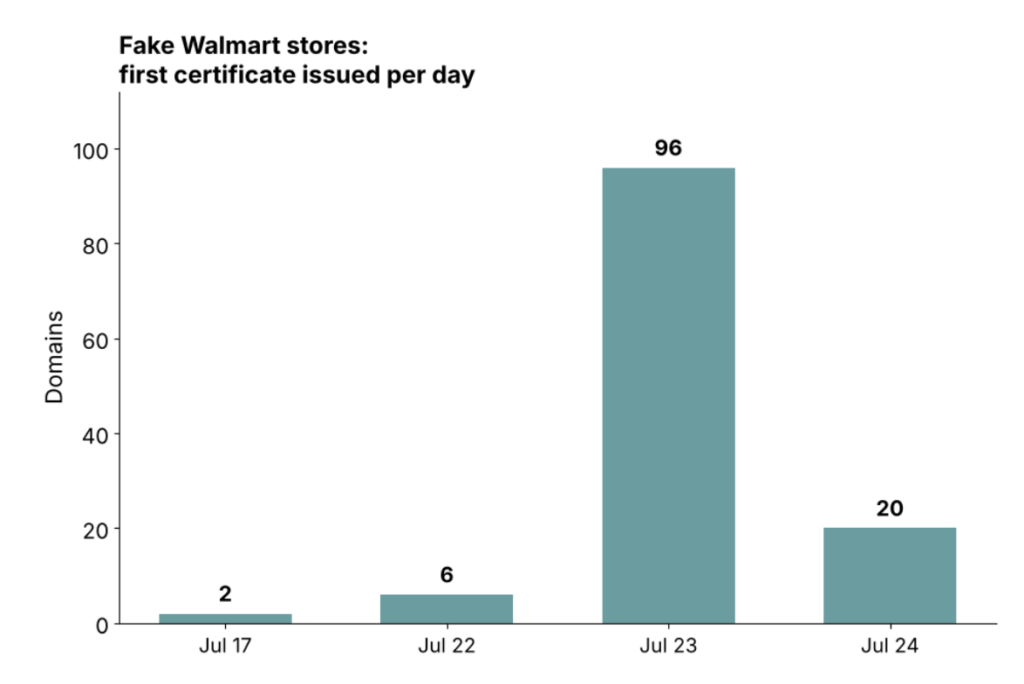
Figure 9: Fake Walmart stores were built in one burst. Fake Walmart stores by the day their first certificate was issued.
Hijacked Websites Sold for Their Visitors
We also found that hackers sell compromised websites for their visitors. Bundles of hijacked sites with steady traffic from the U.S., Europe, and beyond give scammers a ready supply of potential victims who can be redirected to fake storefronts, Black Friday phishing pages, or malicious downloads.
The listing in Figure 10 is typical: one seller auctions administrator access to 18 compromised WordPress sites and advertises them by audience, listing visitor counts by country (53,000 from France, 40,000 from the U.S., 22,000 from Sweden, with smaller numbers from Canada, Germany, Croatia, Kenya, Brazil and elsewhere), roughly 300,000 visitors in all. The starting bid is $1,250 and the buy-now price $1,750: for less than $2,000, a buyer gets an audience of hundreds of thousands of real visitors on sites whose owners likely don’t know they’ve been sold.
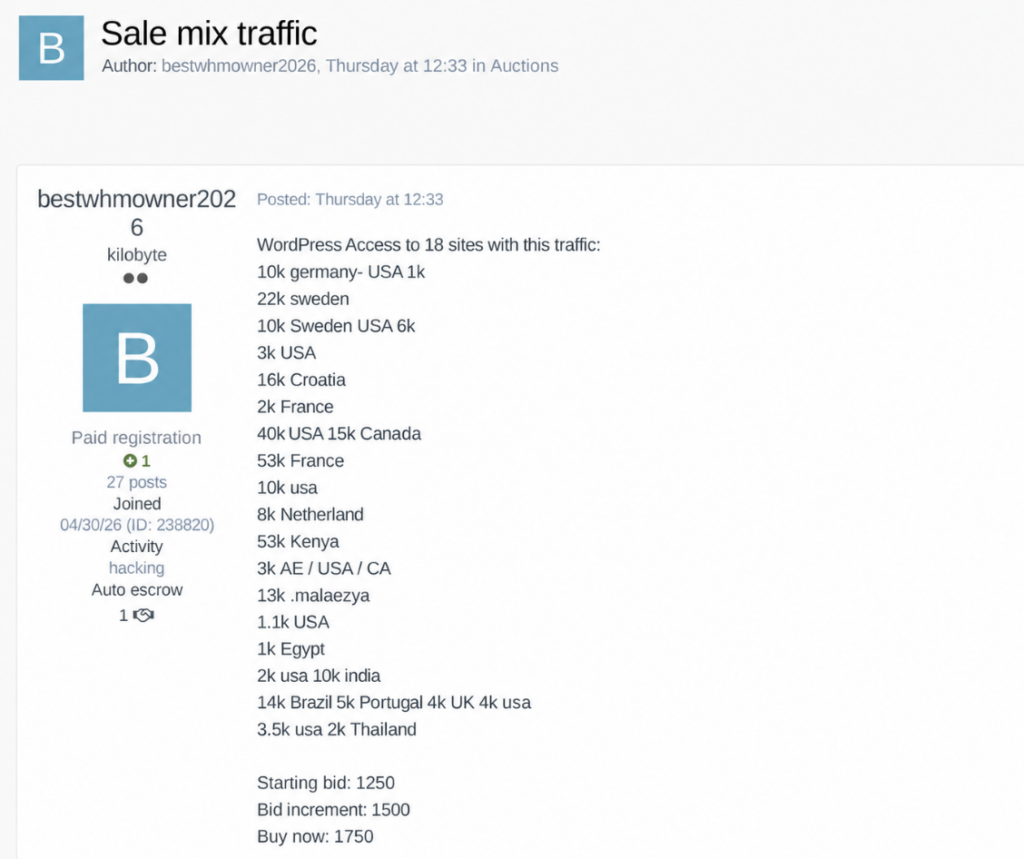
Figure 10: An auction for access to 18 compromised sites. A listing for administrator access to 18 compromised WordPress sites. Source: Exploit – dark web forum
Demand for Personal Data and Stolen Credentials
Our dark web monitoring shows active demand for personal data this fall. Buyers are actively seeking private, non-public U.S. contact records, especially phone numbers, which fuel the fake delivery notifications and fake deal texts that surge every holiday season. Stolen credentials round out the market.
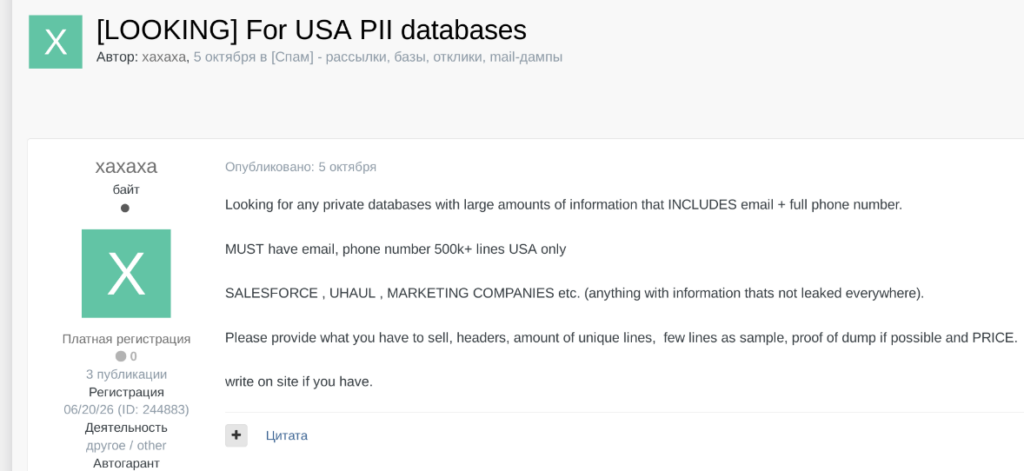
Figure 11: A buyer seeking U.S. personal data databases. A request for private U.S. databases of 500,000 or more records that include email addresses and full phone numbers, naming CRM style and marketing company data as examples and asking sellers for samples and a price. Source: Exploit – dark web forum
In 2025, Fortinet tracked more than 1.57 million login accounts tied to major e-commerce sites collected through stealer logs in a three-month period. Accounts with real purchase histories are especially valuable because they blend in with genuine holiday shoppers.
Criminals Run Their Own Holiday Sales
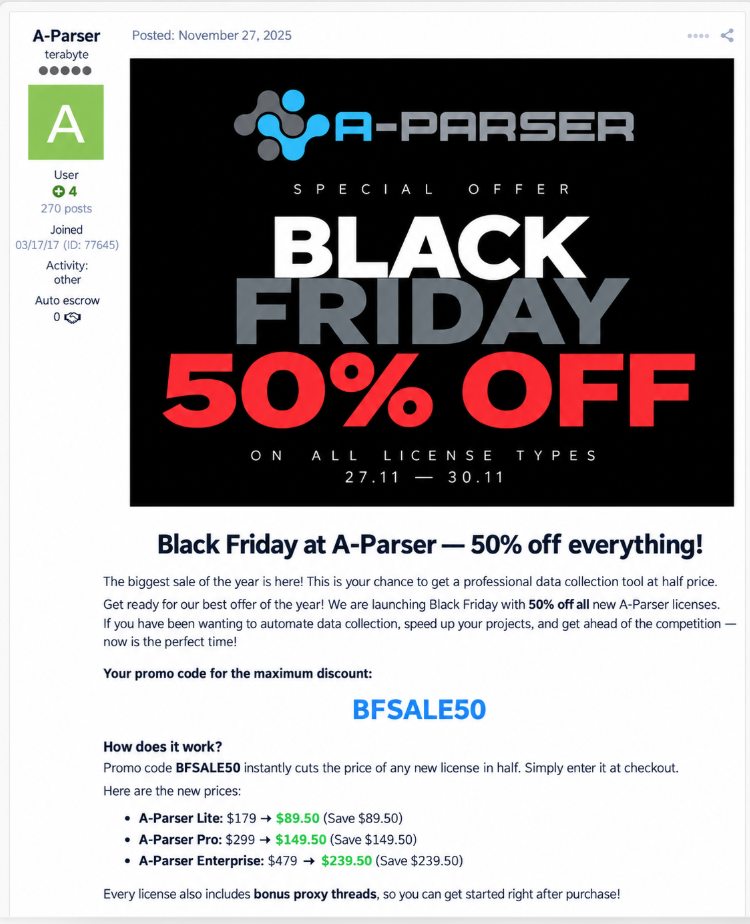
Figure 12: A forum seller advertises Black Friday discounts on a data collection tool. A November 27, 2025 post offering 50% off all license types of A-Parser, a data collection tool, with promo code. (We’re not suggesting the tool or its maker is itself unlawful, only that it was marketed on this forum.) Source: Exploit – dark web forum.
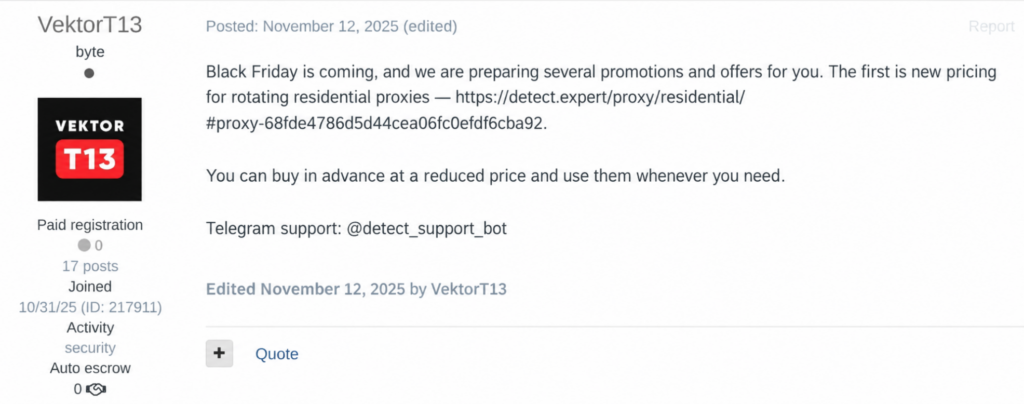
Figure 13: A proxy seller announces Black Friday pricing. A November 12, 2025 post (edited) from a seller of rotating residential proxies, announcing reduced prices for buyers who purchase in advance, the first of several planned Black Friday promotions. Source: Exploit – dark web forum
The underground also mirrors legitimate retail in its promotions. Sellers on the same forums run Black Friday sales on the tools of the trade. In November 2025, the maker of a data collection tool advertised 50% off every license type with the promo code BFSALE50 (Figure 12), and a proxy seller announced reduced prices for rotating residential proxies that buyers could purchase in advance and use whenever they needed (Figure 13). Data collection tools and residential proxies are commonly used to gather information at scale and to hide where traffic originates, so a discount on them makes preparing a campaign cheaper. Both posts appeared within about two weeks of Black Friday 2025 (the A-Parser sale itself ran November 27–30), which fits the pattern described above: sellers target buyers who are preparing for the season. We included these 2025 examples because the cycle repeats: the tools behind holiday scams get cheaper in the weeks before Black Friday, which lowers the cost of entry just as the season begins.
Affiliate Sweepstakes: The Monetization Layer
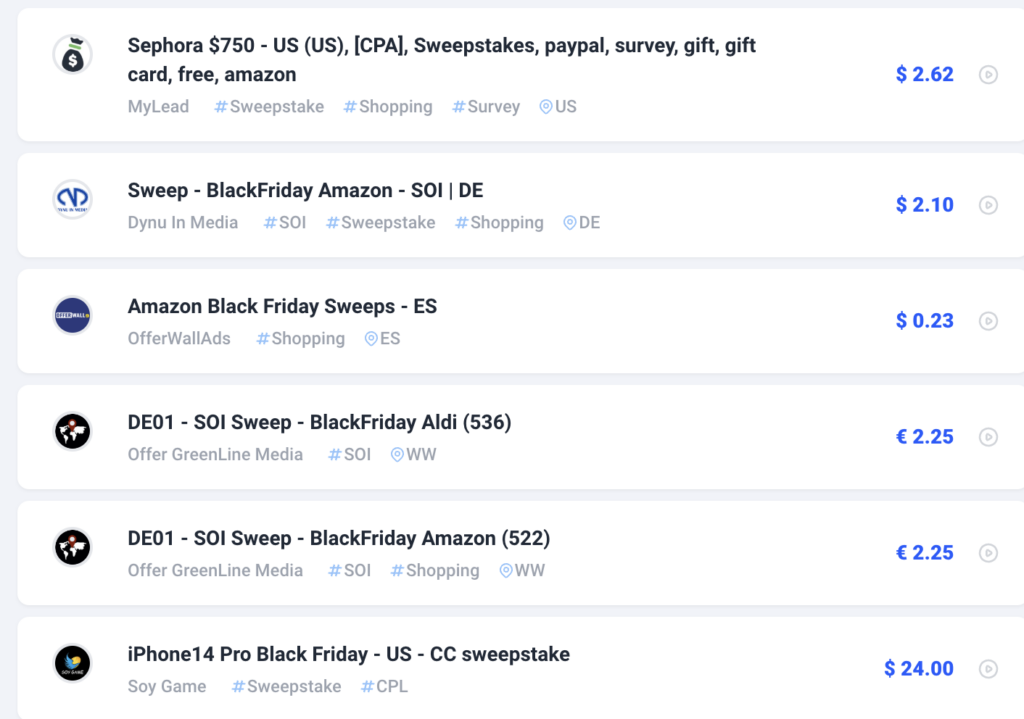
Figure 14: Black Friday sweepstakes offers and their payouts. Six offers from a public affiliate directory, captured on October 18, 2026, with payouts from $0.23 to $24.00 (some in euros). Source: affplus[.]com
So far this holiday season, we have seen scammers run the same play: a seasonal hook, a well-known brand name, and a prize that supposedly costs the visitor “only” an email address or a small fee. Some offers on affiliate marketing networks promote these scams, and anyone can earn a commission for sending visitors to an offer.
The listings above, captured from a public offer directory in October 2026, show Black Friday “sweepstakes” campaigns already live weeks before the shopping season starts. A sweepstakes offer here means a webpage that promises a chance to win something — a gift card, an iPhone, a $1,000 giveaway — in exchange for the visitor’s personal details, such as an email address, a survey, or a credit card. None of the brands named in these listings — Amazon, Aldi, Sephora, Apple — appears to have anything to do with them. The payout beside each offer shows how much the advertiser expects to extract from each visitor.
Cheap single opt-in offers pay under $3 per sign up as soon as someone enters an email address, which spammers add to their lists. The “$750 Sephora” offer sends the visitor through a chain of paid trials and app installs that must be completed before the gift card is “unlocked.” The most expensive one, “iPhone 14 Pro – CC sweepstake” at $24, requires a credit card, usually for a small shipping charge that quietly turns into a monthly subscription.
In our assessment, these campaigns are consistent with scams because the card data is the product, and the money is the clearest proof. A real sweepstakes does not ask for your credit card to enter, and it’s unlikely that a genuine giveaway would pay $24 for every person who signs up. That payout suggests the card is the product. Advertisers can earn it back through recurring subscription charges, or by selling card data to other criminals. Card-capture offers pay about 12 times more than the typical $2 email-only offer because payment card data is the real product.
Other signs point the same way: the brand names are used without permission, the offer titles are written for scammers searching the directory rather than for shoppers, and the “iPhone 14 Pro” prize is about four years out of date, which suggests the page has not been touched in recent years. A real promotion ends, but a scam keeps earning as long as people keep clicking.
The same hooks show up in our data. We found a Shein-branded page promising a “$750 Fashion Gift Card,” and published reports (for example MyAntiSpyware’s write up of one Target gift card site) describe a run of fake $700 to $750 Target gift card pages that follow the same pattern as the Sephora listing. By October 31, our holiday keyword search had also found about 305 sites that refer visitors to counterfeit goods. They are not phishing, but they use the same affiliate-style model, in which traffic is the product.
The Operations at a Glance
| Operation | Domains | Evidence | Attribution |
|---|---|---|---|
| DHL delivery-text operation | about 77 | Three servers at two hosting providers, one shared decoy page, five registration bursts, certificates issued the same day for nearly all | The operator is unknown. One of the hosting providers has been linked in public reporting to criminal forums, because services it owned were advertised on the Cracked and Nulled forums. |
| FedEx look-alikes | 23 | All registered September 22–30, same two servers, near-identical fake challenge page, mostly shared DNS | Unknown operator; the same patterns appear in delivery-brand SMS phishing (smishing) |
| FedEx look-alikes October wave | 75 | 14 registered October 7–19 through one registrar on the same three IP addresses; 61 random-letter .shop and .vip names first seen from October 4 to October 31 | Unknown; not linked to the September group |
| Fake Walmart branded stores | 124 | 61 of 66 registered within a two-hour window, 13 Cloudflare nameserver pairs, 124 of 124 rated malicious | Unknown; possibly a small number of actors |
Table 2: Operations at a glance. Evidence linking the domains in each group, and what we can say about attribution.
A few smaller groups share rare artifacts, such as an unusual page body, a certificate, or a private mail server. We treated two domains as linked only when the shared artifact is rare. Our analysis showed that most apparent connections between domains came from generic pages seen on more than 1,000 hosts, so we discarded them. Shared hosting and registration link domains to each other but don’t identify the operator.
What This Means for Your Organization
- Your brand may be the lure. Scammers register look-alikes and obtain certificates within a day. Monitor new certificates for your brand name, common delivery, rewards, and gift card words.
- Your suppliers are part of the attack surface. Attackers exploit compromised vendor sites and out-of-date checkout plugins to reach shoppers without building their own infrastructure. Ask suppliers who run online stores about plugin patching and checkout monitoring.
- Your employees are targets too. Fake delivery notification texts and gift card lures reach work phones and inboxes as easily as personal ones. Refresh your awareness training before the peak.
- Scams start early in the season. Sweepstakes and delivery lures are live weeks before Black Friday. Warn customers and publish how you will, and will not, contact them.
Mitigation
Holiday scam infrastructure is cheap, fast, and built before the season. We recommend these steps:
- Watch for look-alikes before they go live. Check CT logs daily throughout the holiday season for new certificates that include your brand name or words like “delivery,” “rewards,” and “gift card.” Treat domains registered since July with extra suspicion.
- Look for the build, not just the brand. Fewer than one in 10 of the DHL operation’s domains contained “DHL.” Alert on patterns that persist across waves, such as the same decoy page, registration bursts, and shared name patterns.
- Block and report. Block confirmed malicious domains in your email, web, and DNS controls, and review the suspected ones. Report look-alikes to the registrar, the hosting provider, and any CDN in front of them. Give your brand protection or legal team the evidence early.
- Harden your storefront and checkout. Patch your content management system and checkout plugins before the peak, remove plugins you don’t use, and require multi-factor authentication on every admin account. Review third-party scripts on checkout pages. Alert on new admin users, new files in upload folders, and web shells.
- Treat suppliers’ sites as part of your attack surface. The AI-agent campaign described above hit a product support site and a site run by a third-party vendor. List your microsites, support portals, and agency-run campaign pages. Ask suppliers about patching and checkout monitoring, and require prompt notice of incidents.
- Prepare your people and your customers. Delivery texts and gift card lures reach work phones as easily as personal ones, so refresh awareness training before the peak. Publish how you will, and will not, contact customers, give them a place to report scams, and warn them early.
- Audit your third-party providers. Attackers buy compromised supplier sites for their traffic and use them to redirect shoppers, which exposes your customers even if your own site is secure.
SecurityScorecard’s TITAN AI platform is built for this situation. It continuously monitors your vendors, uncovers hidden third- and fourth-party connections, shows you within minutes which suppliers are exposed when a new breach or vulnerability hits, and helps you work with them to fix the issues attackers are most likely to exploit.
Request a demo to see how STRIKE Threat Intelligence and SecurityScorecard’s Driftnet engine link active holiday scam campaigns, like those in this report, to vendors in your ecosystem.
Indicators of Compromise
The indicators of compromise (IOCs) listed here are domains from this research, defanged. Each was flagged in our investigation and then verified against two independent sources: a malicious or suspicious rating from a threat-reputation service and five or more VirusTotal engines. The DHL and FedEx operations include further domains tied to the same infrastructure that have fewer detections so far. The fake Walmart store domains are not repeated here, as they were listed earlier by Malwarebytes. Ownership and status can change, and this list is provided for defensive use. If you believe a domain is listed in error, contact us.
amazon-account-team[.]com, amazon-africanmarket[.]com, amazon-bonus-it[.]com, amazon-casino[.]club, amazon-deals[.]today, amazon-es[.]cc, amazon-jdasj[.]com, amazon-of-services[.]com, amazon-slot[.]sk, auth-d-h-l[.]top, black-friday-now[.]com, delivery-express[.]info, delivery-express[.]top, dhl-access[.]top, dhl-center[.]top, dhl-cy[.]vip, dhl-delivery[.]org, dhl-deliverykol[.]work, dhl-deliverytio[.]work, dhl-dostava[.]sbs, dhl-ems[.]click, dhl-ems[.]com, dhl-ex[.]com, dhl-globalap[.]us, dhl-help[.]top, dhl-home[.]sbs, dhl-inf[.]com, dhl-klw[.]com, dhl-kurier[.]pl, dhl-kurir[.]sbs, dhl-maomao[.]buzz, dhl-mx[.]live, dhl-my[.]com, dhl-qa[.]com, dhl-sendunginfo[.]de, dhl-track[.]site, dhl-tracker[.]com, dhl-tracking[.]top, dhl-trackingclient[.]com, dhl-vietnam[.]com, dhl-vn[.]vn, express-auth[.]top, express-contact[.]top, express-docs[.]top, express-hub[.]top, express-notice[.]top, express-portal[.]top, express-ship[.]top, express-support[.]top, express-trace[.]top, express-transit[.]top, express-transport[.]top, express-view[.]top, fedex-app[.]link, fedex-assistant[.]live, fedex-da[.]com, fedex-delivery[.]co, fedex-df[.]com, fedex-dk[.]com, fedex-dt[.]com, fedex-dw[.]com, fedex-dy[.]com, fedex-fast[.]com, fedex-jf[.]com, fedex-js[.]com, fedex-tgndfv[.]shop, fedex-vipbfgd[.]shop, fedex-vipbvrfb[.]shop, fedex-vipdsf[.]shop, fedex-vipsdv[.]shop, fedexdw[.]com, fedexgp[.]com, fedexkf[.]com, fedexkkt[.]com, fedexkpt[.]com, fedexkw[.]com, fedexmu[.]com, fedexnx[.]com, fedexpl[.]com, fedexpm[.]com, fedexql[.]com, fedexrf[.]com, fedexrh[.]com, fedexrk[.]com, follow-tracking[.]top, giftcardmallmygiftai[.]com, mytracking435353454363634543[.]top, new-home[.]top, oopbuy-spreadsheets[.]christmas, oopbuyse[.]christmas, postal-express[.]top, shein-box[.]promo, shein-entregas[.]com, shein2[.]net, shein6[.]shop, shein[.]online, sheinretail[.]com, sheinvip[.]buzz, sheiny[.]shop, shipment-here[.]top, superbuyfr[.]christmas, temu-gifts[.]com, temu-online[.]com, temu-th[.]info, temu888[.]buzz, temu[.]golf, temuaustralia[.]xyz, temucouponhub[.]com, temud[.]art, temudfdfe[.]top, temudfsdf[.]top, temuexpert[.]com, temuhati[.]top, temuiphone[.]com, temumoney[.]site, temun[.]shop, temune[.]com, temustore3[.]shop, track-plus[.]top, tracking-anywhere[.]top, tracking-express[.]top, tracking8675757676878778[.]top, trackingexpress[.]top, trading[.]christmas, ups-algerie[.]com, ups-authorization-request[.]com, ups-douane[.]com, ups-espacetracking-ch[.]com, ups-global-shipping[.]com, ups-kontaktieres-de[.]com, ups-parcel[.]com, ups-rila[.]app, ups-shipping[.]us, ups-sign[.]help, ups-tracking-alert[.]com, usps-delivery-canada[.]com, usps-delivery[.]info, usps-dl[.]shop, usps-infohk[.]top, usps-shop[.]co, usps-tool[.]top, usps-us[.]lol, usps-vi[.]cc, walmartcard[.]cc, walmartchevks[.]com, win88login[.]christmas