Three of the largest names in global finance disclosed data exposures on the same day, and attackers breached none of them directly. On November 19, 2026, JPMorgan Chase, Mastercard, and Visa each reported a cyberattack on a third-party service provider. This third-party data breach shows how one vendor’s compromised credentials can quietly reach the customers of many companies at once.
The payment networks stayed online, and no card numbers were leaked. Still, the incident carries a lesson for every security and risk leader: your exposure extends as far as your vendors’ access does.
What Happened in the Chase, Visa, and Mastercard Vendor Breach
All three disclosures point to marketing and contact data exposed through outside providers.
- JPMorgan Chase: Attackers targeted third parties that provide services to the bank and accessed certain marketing data those vendors held. That data may include some customer names and email addresses. Chase found no disruption to its services and will offer complimentary credit monitoring to affected customers where appropriate.
- Mastercard: Attackers hacked one of its third-party providers and exposed email addresses from a small subset of cardholders enrolled in a specific benefit program. Mastercard reported no impact to its payment network.
- Visa: A third-party provider in the Asia-Pacific region experienced a data breach. Visa said its own systems were not involved and that no payment data, such as card numbers, was affected.
None of the three companies named the vendor or disclosed how many customers the incident affected.
The Suspected Root Cause: Trusted Cloud Access Left Open
BleepingComputer reported that Qubole, a cloud data analytics company owned by Idera, is the suspected third-party provider. That links the disclosures to a supply chain attack researchers had already documented.
On November 9, researchers at Wiz, working with Sentra and Mandiant, published their findings. They observed a threat actor using credentials from Qubole’s Amazon Web Services (AWS) account between October 14 and October 26, 2026. The attacker used those credentials to assume Identity and Access Management (IAM) roles that customers had created to trust Qubole.
An IAM role works like a key that one cloud account hands to another. Many software-as-a-service platforms use these cross-account roles to process data inside a customer’s environment. That convenience carries a cost: a breach at the vendor can open the door to every customer that trusts it.
Two details from the research stand out:
- Dormant access stayed live. Wiz reported that most of the roles the attacker assumed sat unused apart from the attack. Some belonged to companies that had stopped using Qubole entirely. The trust relationship outlived the business relationship. n0n has since threatened to list every former Qubole customer on its leak site.
- The attacker moved quickly. Once inside, the attacker searched cloud storage and pulled secrets, passwords, and keys from customer environments. Sentra reported that the attacker collected roughly 100 passwords and keys within seven minutes.
The Extortion Group Behind the Claims
A ransomware and extortion group called n0n, first tracked by researchers in mid-September 2026, claimed responsibility for the Qubole attack on November 11. On November 16, the group posted data it claimed came from Chase, Visa, and Mastercard on its extortion site.
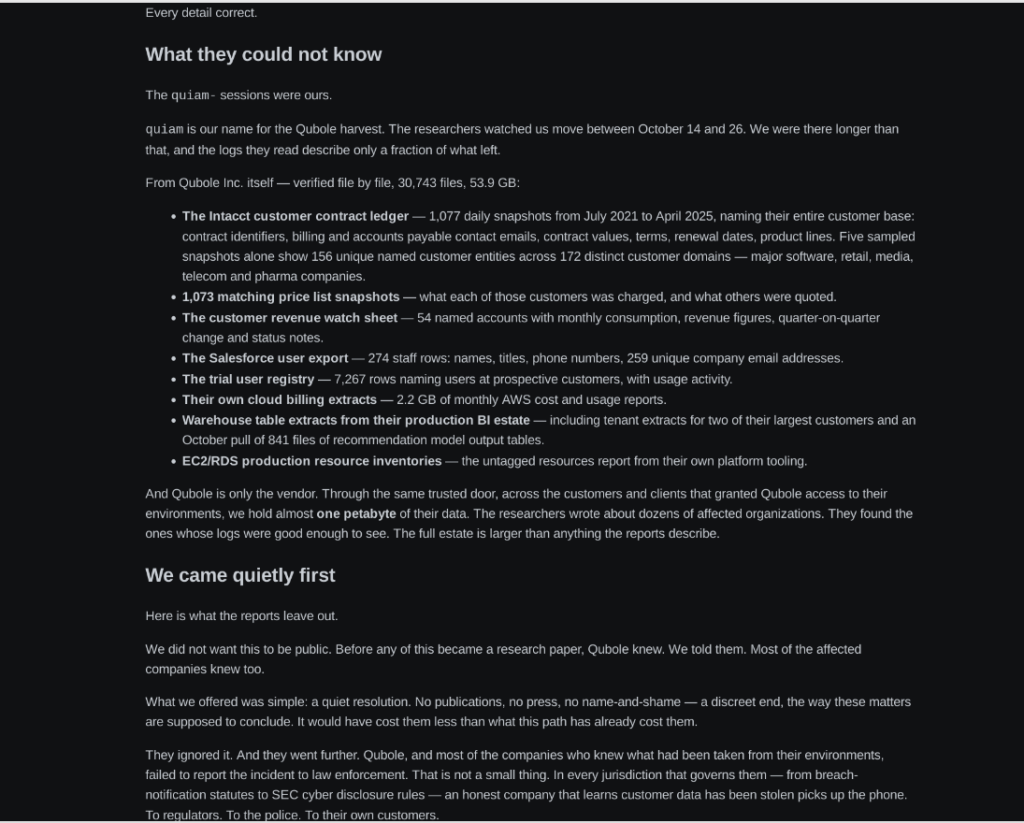
Figure 1: Excerpt from n0n’s blog post “Qubole: The Trust That Was Sold,” in which the group claims the Qubole intrusion, November 11, 2026
The group claims it stole 53.9 GB across 30,743 files directly from Qubole, plus nearly one petabyte of data from Qubole’s customer networks. Nobody has verified those figures, so treat them as attacker claims until confirmed. Extortion groups routinely inflate their numbers to pressure victims into paying.
The timing of the leaks points to a single shared vendor. An analysis of n0n’s leak site, captured on November 19, shows JPMorgan Chase, Visa, and Mastercard as the first three organizations whose data the group published in one batch, between 09:12 and 09:14 UTC on November 16. Neither n0n nor the companies have named the vendors involved.
n0N’s site applies pressure in stages. Each victim moves from Pending to Exposed to Leaked, with a countdown at each step. The JPMorgan listing is marked “NOT PAID — LEAKED” and carries a “THEY KNEW” tag, which the group applies to victims it claims ignored a private extortion offer. An “Aftermath” page tracks lawsuits, regulator action, and customer notifications at past victims as a warning to future ones. The name on a listing is the brand whose data appears in the leak, not necessarily the company whose network was breached. That is how all three companies can appear on the site while reporting that the attack hit their vendors.
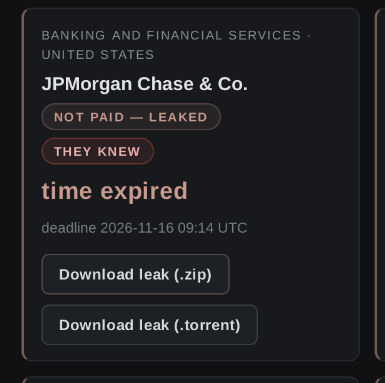
Figure 2: The JPMorgan Chase listing on n0n’s leak site.
SecurityScorecard’s 2025 Global Third-Party Breach Report found that 35.5% of all breaches in 2024 were third-party related. Ransomware also made up a larger share of third-party breaches than of breaches overall. Threat actors favor vendor access because one compromise scales across many victims.
Why Financial Services Faces Outsized Third-Party Risk
Banks and payment companies rely on marketing platforms, analytics tools, loyalty program operators, and cloud data services that all touch customer information. Each one adds a path an attacker can use. SecurityScorecard research shows how common these exposures have become:
- 97% of the top 100 U.S. banks experienced a third-party breach in 2024. The same share suffered a fourth-party breach, and just 2% of vendors drove those incidents.
- 41.8% of breaches impacting leading fintech companies originated with third-party vendors.
- Financial services ranked as the fourth most-breached industry through third parties, according to SecurityScorecard’s lessons from the biggest financial sector breaches.
This incident fits that pattern: a single analytics provider sat between attackers and the customer data of several major institutions.
The n0n campaign also shows how vendor access lets attackers reach larger targets. Financial services is the group’s third most-targeted sector, with 35 of 233 listings (15%). Until November 16, its financial victims were smaller fintech, investment, FX-trading, and advisory firms. JPMorgan Chase is the first global bank the group has named, and the two card networks appear only in the same November 16 wave. The group appears to have reached the largest institutions through a shared vendor rather than by breaching them directly.
| Leak date (UTC) | Type of organization | Country |
| Nov. 16, 2026 | Global bank (JPMorgan Chase), two payment card networks (Visa and Mastercard), a fintech payments company, an investment advisory firm | United States |
| Nov. 6, 2026 | Precious-metals dealer | United States |
| Oct. 20, 2026 | Banking payments-software vendor | United States |
| Oct. 18, 2026 | FX liquidity and trading-technology firm | Netherlands |
| Sept. 20, 2026 | Digital-securities platform | Luxembourg |
Table 1: Selected financial-services organizations n0n listed as leaked. Source: n0n leak site, captured November 19, 2026.
Six Steps to Reduce Your Vendor Exposure Now
The fastest wins come from reviewing access you already granted.
1. Hunt for dormant vendor trust relationships. Audit every cross-account IAM role and Application Programming Interface (API) integration tied to an outside provider. Remove access for any vendor you no longer use. Wiz recommends that Qubole customers review AWS CloudTrail logs, which record account activity, back to October 1, 2026.
2. Rotate secrets that vendors could reach. If a vendor role could read your secrets store, assume those credentials are exposed. Rotate keys, passwords, and tokens tied to cloud, identity, and single sign-on services.
3. Map your fourth parties. Your vendors rely on their own providers. Fourth-party visibility shows you those hidden dependencies before attackers exploit them.
4. Replace annual reviews with continuous monitoring. Most security teams still assess vendors once a year. Attackers moved through Qubole’s customers in under two weeks. Continuous monitoring flags changes in a vendor’s security posture as they happen.
5. Tier vendors by data access, not spend. A low-cost marketing tool can hold millions of customer emails. Rank vendors by the sensitivity of the data and systems they touch, and apply your deepest scrutiny to the highest-access tier.
6. Prepare for the phishing that follows. Leaked names and email addresses fuel targeted phishing. Warn employees and customers to distrust unexpected messages that mention the breach or ask them to “verify” an account, and watch for look-alike domains and fake support channels that exploit the news. Add third-party breaches to your incident response plan, with named owners for vendor contact, customer communication, and regulatory notification.
For a broader framework, read SecurityScorecard’s guide to identifying and mitigating third-party risk.
How Continuous, Threat-Informed Monitoring Changes the Response
Questionnaires capture what a vendor says at one moment. They cannot tell you when a provider appears on a ransomware group’s leak site or when its credentials surface in criminal markets.
SecurityScorecard’s TITAN AI platform combines threat intelligence with third-party risk data to close that gap. TITAN Watch continuously monitors your vendors and uses Automatic Vendor Detection to surface third and fourth parties you may not know you depend on. When a provider shows signs of compromise, your team can act before the exposure reaches your customers.
Trust Needs an Expiration Date
Attackers succeeded because companies granted a vendor access and never took it back. That access sat idle until someone else used it.
Leaders who inventory vendor access, monitor providers continuously, and act on threat intelligence will catch these exposures early. Leaders who rely on annual reviews will learn about them from the news.
See how exposed your vendor ecosystem is today. Explore the TITAN AI platform or download the 2025 Global Third-Party Breach Report to benchmark your program against the latest data.